Governorship Election in Anambra State and the Role of Blogs and Youtube Channels

Downloads
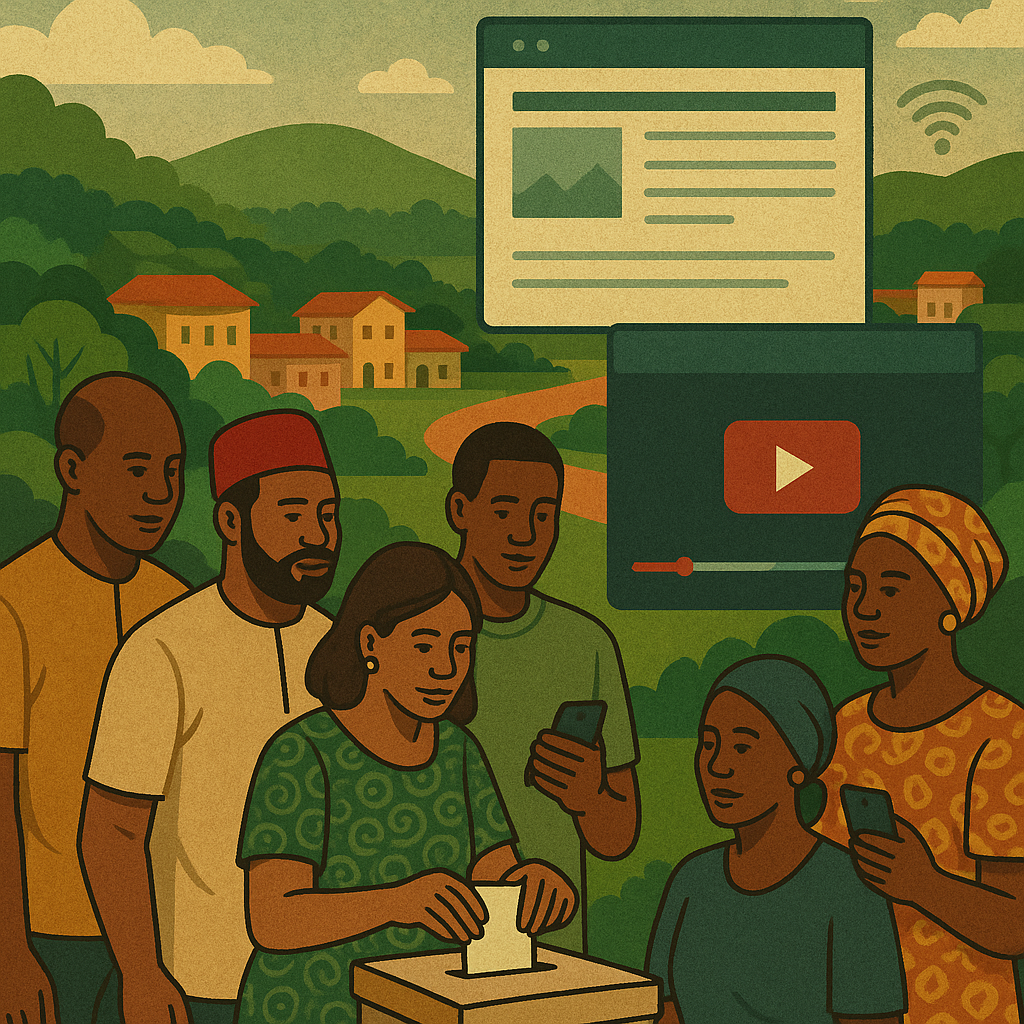
Social media platforms have been identified as a new possibility that enhance political process and build a robust democracy in the modern world. The reason of the study is to evaluate the effect of blogs and Youtube on voters’ participation in the 2021 governorship election in Anambra State, Nigeria. Survey research design was adopted, and the sample size of 347 registered voters were used for the study. This was determined using proportionate stratified random sampling and convenience sampling techniques. The instrument used for data collection was questionnaire which was face validated while test-retest reliability was employed to verify the internal consistency. The study data were analyzed using the Statistical Package for Social Sciences (SPSS) 27 software. multiple regression analysis was employed to assess research hypotheses at 0.05 significance level. Findings revealed that Youtube and Blogs/forums have significant effect on voters’ participation in the 2021 governorship election in Anambra State The study recommended among others that political candidates should improve their strategies especially where it concern blogs to engage citizens by understanding the public’s perception of political parties and how shared content on blogs and Youtube platforms which influences their intention to vote.
Abdulrauf, A. A., Hamid, N. A., & Ishak, S. (2015). Social media and youth online political participation: Perspectives on cognitive engagement. New Media and Mass Communication, 44, 8-15. https://www.iiste.org/Journals/index.php/NMMC/article/ view/27757
Abubakar, A. A. (2012). Political participation and discourse in social media during the 2011 presidential electioneering. The Nigerian Journal of Communication, 10(1), 96‒116.
Adeniyi, W. K. (2023). Power to the people: Social media as a catalyst for political participation in Nigeria. International Journal of Interactive Communication Systems and Technologies 12(1), 1-10. Doi: 10.4018/ijicst.320652
Aghogho, J. E. (2020). Public perception of social media contributions to political participation processes in Delta State, Nigeria.Acta Universitatis Danubius Vol. 14, No. 1/2020
Aharony, N. (2012). Twitter use by three political leaders: An exploratory analysis. Online Information Re-view, 36(4), 587-603. http://dx.doi.org/10.1108/14684521211254086.
Ajzen, I. (1991). The theory of planned behavior. Organizational Behavior and Human Decision Processes, 50(2), 179-211.
Akosua, G. M. (2020). The Impact of social media on political communication in Ghana. School of Graduate Studies and Research, Ghana Institute of Journalism.
Arthur, C. (2012). Encouraging Political Participation in Africa. Retrieved from http://www.issafrica.org
Atinuke, B. (2022). Influence of social media networking on academic achievement of senior secondary school students in Abuja. FUOYE international Journal of Education, 5(1), 77-87.
Ayeni, T.P (2019) The role of social media in voter sensitization in Nigeria. American Journal of Computer Science and Information Technology, 7(1), 33-41. Doi: 10.21767/2349-3917.100033
Bernard, E. (2011). How do social media change the conditions for civic and political mobilization? Retrieved from<http://nrk.no/terrortwitter
Blood, R. (2000). Weblogs: A history and perspective. Retrieved from http://www.rebeccablood.net/essays/weblog_history
Breuer, A., & Groshek, J. (2014). Slacktivism or efficiency-increased activism? Online political participation and the Brazilian Ficha Limpa anti-corruption campaign. In: Y. Welp, & A. Breuer (eds.) Digital Oppor-tunities for Democratic Governance in Latin America, Routledge, 165-182. Doi: 10.4324/9780203361986-10
Chang, M. T. (2010). Different Blog Use, Different Participation. (Unpublished Graduate Program of Radio and Television), National Chengchi University.
Chinedu-Okeke, C. F. and Obi, I. (2016) Social media as a political platform in Nigeria: A focus on electorates in South-Eastern Nigeria. IOSR Journal of Humanities and Social Science, 21(11), 6-22. Doi: 10.9790/0837-2111010622
Diamond, L. (2010). Liberation technology. Journal of Democracy, 21(3), 69–83.
Ekwueme, M., & Folarin, S. (2017). Role of social media in electioneering: The case of the Nigerian 2015 presidential election. In Proceeding of the Covenant University Conference on e-Governance in Nigeria (CUCEN2017), pp. 299-311.
Fiveable (2024). Voter participation. Retrieved from https://library.fiveable.me/key-terms/apush/voter-participation
Fuchs, C. (2014). Social Media: A critical introduction. London: Sage
Gidengil, E., Wass, H. & Valeste, M. (2016). Political socialization and voting: The parent child Link in turnout. Political Research Quarterly, 69(2), 373-383. Doi:10.1177/1065912916640900
Goodrow, C. (2017). You know what’s cool? A billion hours. youtube. Retrieved from https://blog.youtube/news-and-events/you-know-whatscool-billion-hours/
Hale, J. (2019). More than 500 Hours of Content Are Now Being Uploaded to YouTube Every Minute.” Tu-befilter. Retrieved from https://www.tubefilter. com/2019/05/07/number-hours-video-uploaded-to-youtube-per-minute/
IseOlorunkanmi, O. J., Olanrewaju, A. F., Oduola, J. O., Nweke-Love, H. C., Kodi, E. E. & Akinojo, I. C. (2023). The influence of social media on political communication: A case study of Nigeria's 2023 general elections in Omu-Aran. International Journal of Advanced Academic Research, 9(7), 31-46. https://www.openjournals.ijaar.org/index. php/ijaar/article/view/43
Lambe, K. M., Olamide, H. O., Adesina, L. A., Udende, P. & Mustapha, M. L. (2023). Social Media and changing political behaviors among the youth in Kwara State of Nigeria, Democratic Communiqué, 31(2), 37-57. Doi: https://doi.org/10.7275/xvvk-7m53
Medimorec, D., Parycek, P., & Schossböck, J. (2011). Vitalizing democracy through e-participation and open government: An Austrian and Eastern European perspective. Retrieved from http://www.bertelsmann-stiftung.de/cps/rde/xbcr/SID-9CAA7CF5-908C191E/bst/Dan-iel%20Medimorec.pdf
Mohammed, A. (2019) The influence of social media on the voting behaviour of tertiary students in the Wa Municipality: Ghana’s 2016 general elections in perspective. University For Development Studies Wa Mu-nicipality: Ghana.
Mohammed, N. & Ogwuche, P. O (2021). Political marketing and social media use in Nigerian politics: Understanding the nexus. Madonna Journal of Communication Studies, 3(1), 7-22.
Neufeld, D. (2021). The 50 most visited websites in the world. Visual capitalist. Retrieved from https://www.visualcapitalist.com/the-50-mostvisited-websites-in-the-world/
Newman C. E. & Gabriel A O. (2016). Social media marketing on organizational efficiency of deposit money banks in Nigeria.Department of Marketing, Rivers State University, Port Harcourt, Nigeria.
Nwador, C. A. & Dike, L. B., Origbo, H. (2020) Social media marketing and political participation of electorate in Rivers State, Nigeria. International Journal of Management Sciences, 8(2), 78-103. https://www.arcnjournals.org/images/ASPL-IJMS-8-2-6.pdf
Nwankwo, C. A., Kanyangale, M., & Abugu, J. O. (2019). Online shopping industry and its consumers in
Nigeria. Journal of Economics, Management and Trade, 24(3), 1-12.
Obi, E.C., Okoli, O., Chiaghana, C & Ono, G.N. (2022). Political awareness campaign as a probable in-
fluence on Anambra women participation in politics. UNIZIK Journal of Gender Research (UJGR), 1(1), 149-173.
Okeke, A.F (2023). Effect of internet marketing performance of selected banks in Abia State. RIK International Journal of business and management, 7(1), 58-74.
Okoro, N. & Nwafor, K. A. (2013). Social media and political participation in Nigeria during the 2011 general elections: The lapses and the lessons. Global Journal of Arts Humanities and Social Sciences, 1(3), 29-46.
Okoro. V. O., Ugonna, I. A., Nebo, G. N. & Obikeze C. O. (2017). Effects of the social media in the marketing of political candidates in Nigeria. British Journal of Marketing Studies, 5(6), 15-32. https://www.eajournals.org/wp-content/uploads/Effects-of-the-Social-Media-in-the-Marketing-of-Political-Candidates-in-Nigeria.pdf
Oluwasola F. O. (2022). The ‘tag generation’: Social media and youth participation in the 2019 General Election in Nigeria. Africa Development, 47(2),107-145
Onwunyi, U. M. and Victor, E. U., (2022). Social media and voter sensitization in Nigeria: A retrospective analysis of the 2019 general election. Asian Journal of Social Science and Management Technology, 4(5) https://ssrn.com/abstract=4419975
Oyewole, J. A. (2022). Correlations between Exposure to YouTube-Casting and Partisan Political Awareness. European Journal of Behavioral Sciences, 5(4), 11-20. https://doi.org/10.33422/ejbs.v5i4.922
Prayogo P. H., Irmawan R., La M., Yessy M. S. & Elsyaff A. M. (2022) Social media contribution as a political communication strategy tool in forming the political image of presidential candidates in the 2019 Pilpres in Indonesia. Journal of Theoretical and Applied Information Technology 100(22), 1-15
Seelye, K. Q. (2007). New presidential debate site? Clearly, YouTube. The New York Times. Retrieved from https://www.nytimes.com/2007/06/13/us/politics/13cnd-youtube.html
Shamsu D. A., Bahtiar M., & Suhaini M. (2017).Youth online political participation: The role of facebook use, interactivity, quality information and political interest. SHS Web of Conferences. shsconf/201 i-COME'16
Smith, A. (2009). The Internet’s role in campaign 2008. Retrieved from https://www.pewresearch.org/internet/2009/04/15/the-internets-role-in-campaign-2008-2/
Sumaira T., Ummel B., Bushra A. and Rizwan S. (2015) Impact of social media on political efficacy and vote intention: A case of educated youth. JISR-MSSE 13(1), 1-9
Taufik Ahmad, Aima, A. & Muhammad, I. (2019). The use of social media on political participation among university students: An analysis of survey results from Rural Pakistan. Sage Open, 9(3). https://doi.org/10.1177/2158244019864484
Unwuchola, A. A., Adinlewa, T., & Udeh, K. (2017). An Appraisal of the role of ICT as a tool for participa-tory democracy in Nigeria. Media and Communication Current, 1(1), 69-87.
Vesnic-Alujevic, L. & Van Bauwel, S. (2014) YouTube: A political advertising tool? A case study of the use of YouTube in the campaign for the European parliament elections 2009. Journal of Political Marketing, 13(3), 195-212.
Yamane, T. (1967). Statistics: An Introductory Analysis (2nd Edition), New York: Harper and Row.
Copyright (c) 2025 Rita Oluebube Nwafor, Cosmas Anayochukwu Nwankwo, Adaora Florence Okeke, Nkoli Augustina Chendo (Author)

This work is licensed under a Creative Commons Attribution-NonCommercial-NoDerivatives 4.0 International License.
By submitting your manuscript to IJABS, you agree and confirm that the paper you have submitted is your own original and unpublished work, does not contain any defamatory or other unlawful content(s), and you will accept responsibility for plagiarism. You and your co-authors retain copyright and grant BESRA the right of publication, with the work simultaneously licensed under a Creative Commons Attribution License 4.