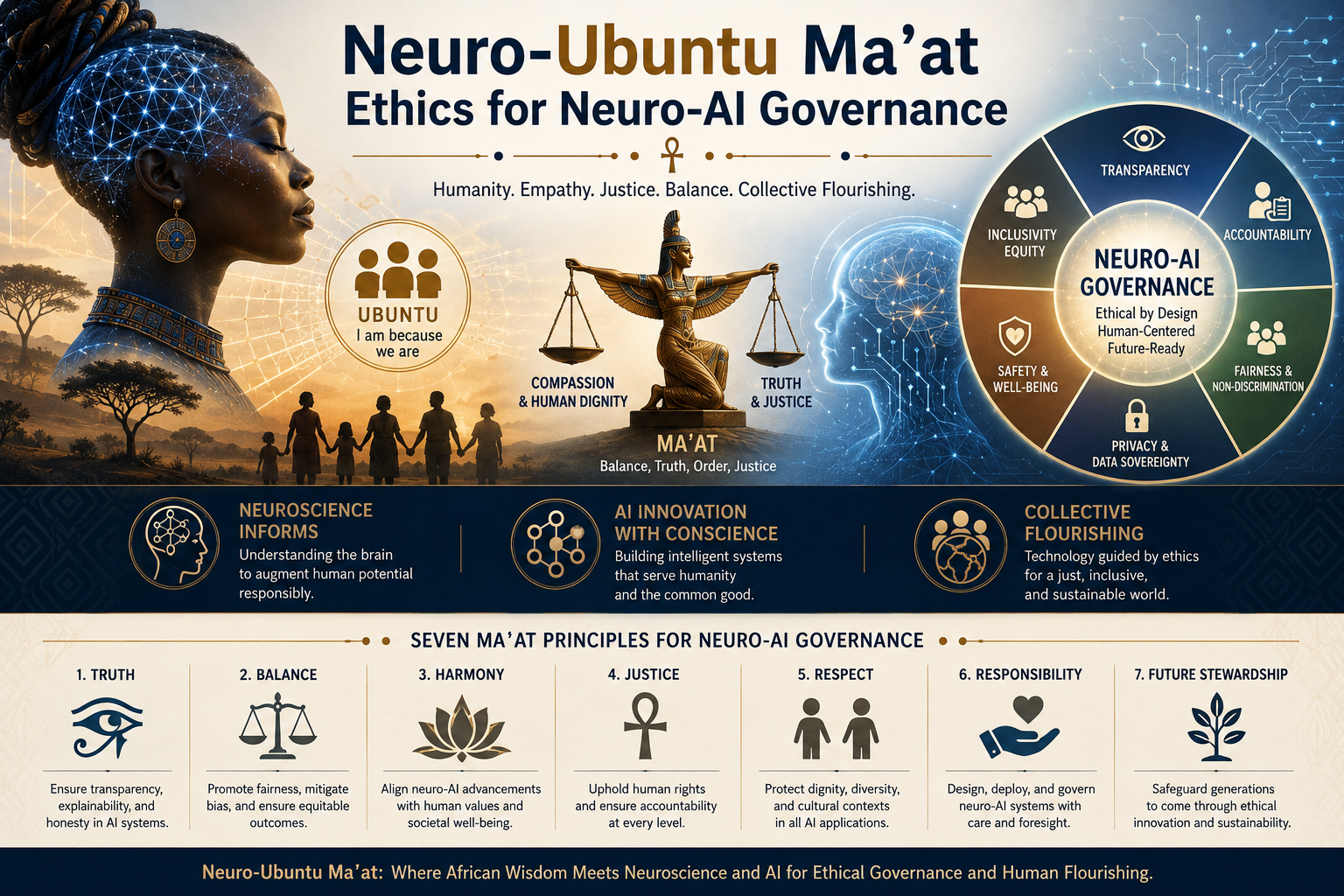
Neuro-Ubuntu Maʽat Ethics for Neuro-AI Governance in Africa

Downloads
This article develops a normative framework for governing neuro-AI in African business and policy contexts. Drawing on a structured literature review of neuroethics, neural data governance, neurorights, and African philosophy, the article argues that prevailing regulatory approaches remain insufficient for many African settings because they rely predominantly on individualist models of autonomy and consent. In response, the article proposes Neuro-Ubuntu Maʽat (NUM) Ethics, a synthetic framework integrating Ubuntu, Maʽat, and broader traditions of African ethical thought. The framework is organised around five principles—mind-dignity, relational personhood, Maʽatian balance, character-centred governance, and communal responsibility—and translated into governance mechanisms relevant to firms, regulators, and civil society. The article also develops the concept of cognitive extractivism to describe the extraction, commodification, and monetisation of neural data without adequate protections for dignity, mental privacy, or fair benefit-sharing. The article contributes to business ethics and technology governance by articulating an African-centred approach to neurotechnology regulation that is philosophically grounded, comparatively situated, and institutionally actionable.
Andanda, P., & Düwell, M. (2024). Relational approaches to neuroethics and human rights. Neuroethics. Advance online publication.
Beauchamp, T. L., & Childress, J. F. (2019). Principles of biomedical ethics (8th ed.). Oxford University Press.
Botes, M., Labuschaigne, M., Casteleyn, C., Inkster, B., & Sheppard, B. (2025). Decoding the brain, respecting the person: A neuroethical inquiry into consent and cognitive liberty in South Africa. Neuroethics. Advance online publication. https://doi.org/10.1007/s12152-025-09615-3
Braun, V., & Clarke, V. (2006). Using thematic analysis in psychology. Qualitative Research in Psychology, 3(2), 77–101. https://doi.org/10.1191/1478088706qp063oa
Cheung, E. (2026, March 13). In a first for China, Neuracle's implantable brain-computer interface wins approval. South China Morning Post. https://www.scmp.com/business/banking-finance/article/3346495/first-china-neuracles-implantable-brain-computer-interface-wins-approval
Couldry, N., & Mejias, U. A. (2019). The costs of connection: How data is colonizing human life and appropriating it for capitalism. Stanford University Press.
De Sousa Santos, B. (2018). The end of the cognitive empire: The coming of age of epistemologies of the South. Duke University Press.
Eke, D. O. (2024). Ethics and governance of neurotechnology in Africa: Lessons from AI. JMIR Neurotechnology, 3, e56665. https://doi.org/10.2196/56665
Ewuoso, C., & Hall, S. (2019). Core aspects of ubuntu: A systematic review. South African Journal of Bioethics and Law, 12(2), 93–103. https://doi.org/10.7196/SAJBL.2019.v12i2.679
Farahany, N. A. (2023). The battle for your brain: Defending the right to think freely in the age of neurotechnology. St. Martin's Press.
Gyekye, K. (1995). An essay on African philosophical thought: The Akan conceptual scheme (Rev. ed.). Temple University Press.
Ienca, M., & Andorno, R. (2017). Towards new human rights in the age of neuroscience and neurotechnology. Life Sciences, Society and Policy, 13(1), Article 5. https://doi.org/10.1186/s40504-017-0050-1
Karenga, M. (2004). Maat, the moral ideal in ancient Egypt: A study in classical African ethics. Routledge.
Matshabane, O. P., et al. (2024). Advancing neuroethics in Africa. South African Journal of Science, 120(5/6), Article 18180. https://doi.org/10.17159/sajs.2024/18180
Metz, T. (2022). A relational moral theory: African ethics in and beyond the continent. Oxford University Press.
Molefe, M. (2019). An African philosophy of personhood, morality, and politics. Palgrave Macmillan.
Musole, E. (2026). Governing neural data in the Global South: Toward a neuro-responsible business framework for Zambia. International Journal of Advanced Business Studies, 5(1), 47–61. https://doi.org/10.59857/g3bvjx74
Ndlovu-Gatsheni, S. J. (2018). Epistemic freedom in Africa: Deprovincialization and decolonization. Routledge.
Obenga, T. (2004). African philosophy: The pharaonic period, 2780–330 BC. Per Ankh.
OECD. (2019). Recommendation of the Council on Responsible Innovation in Neurotechnology. OECD. https://legalinstruments.oecd.org/en/instruments/OECD-LEGAL-0457
Pati, D., & Lorusso, L. N. (2018). How to write a systematic review of the literature. HERD: Health Environments Research & Design Journal, 11(1), 15–30. https://doi.org/10.1177/1937586717747384
Reuters. (2026, March 13). China approves market launch of brain-computer interface medical device in world first. Reuters. https://www.reuters.com/business/healthcare-pharmaceuticals/china-approves-market-launch-brain-computer-interface-medical-device-world-first-2026-03-13/
Snyder, H. (2019). Literature review as a research methodology: An overview and guidelines. Journal of Business Research, 104, 333–339. https://doi.org/10.1016/j.jbusres.2019.07.039
UNESCO. (2023). An ethical framework for neurotechnology. UNESCO.
UNESCO. (2025). AI and digital transformation in Africa. UNESCO.
Wiredu, K. (1996). Cultural universals and particulars: An African perspective. Indiana University Press.
Xinhua. (2026, March 5). China identifies brain-computer interfaces as an industry of the future in government work report. Xinhua. http://en.ce.cn/Insight/202603/t20260303_2801486.shtml
Yuste, R., Goering, S., Arcas, B. A. y, Bi, G., Carmena, J. M., Carter, A., Fins, J. J., Friesen, P., Giordano, J., Haggerty, J., Illes, J., Kellmeyer, P., Lee, W., Meyer, M. N., Pustilnik, A., & Wolpaw, J. (2017). Four ethical priorities for neurotechnologies and AI. Nature, 551(7679), 159–163. https://doi.org/10.1038/551159a
Copyright (c) 2026 Edward Musole (Author)

This work is licensed under a Creative Commons Attribution-NonCommercial-NoDerivatives 4.0 International License.
By submitting your manuscript to IJABS, you agree and confirm that the paper you have submitted is your own original and unpublished work, does not contain any defamatory or other unlawful content(s), and you will accept responsibility for plagiarism. You and your co-authors retain copyright and grant BESRA the right of publication, with the work simultaneously licensed under a Creative Commons Attribution License 4.