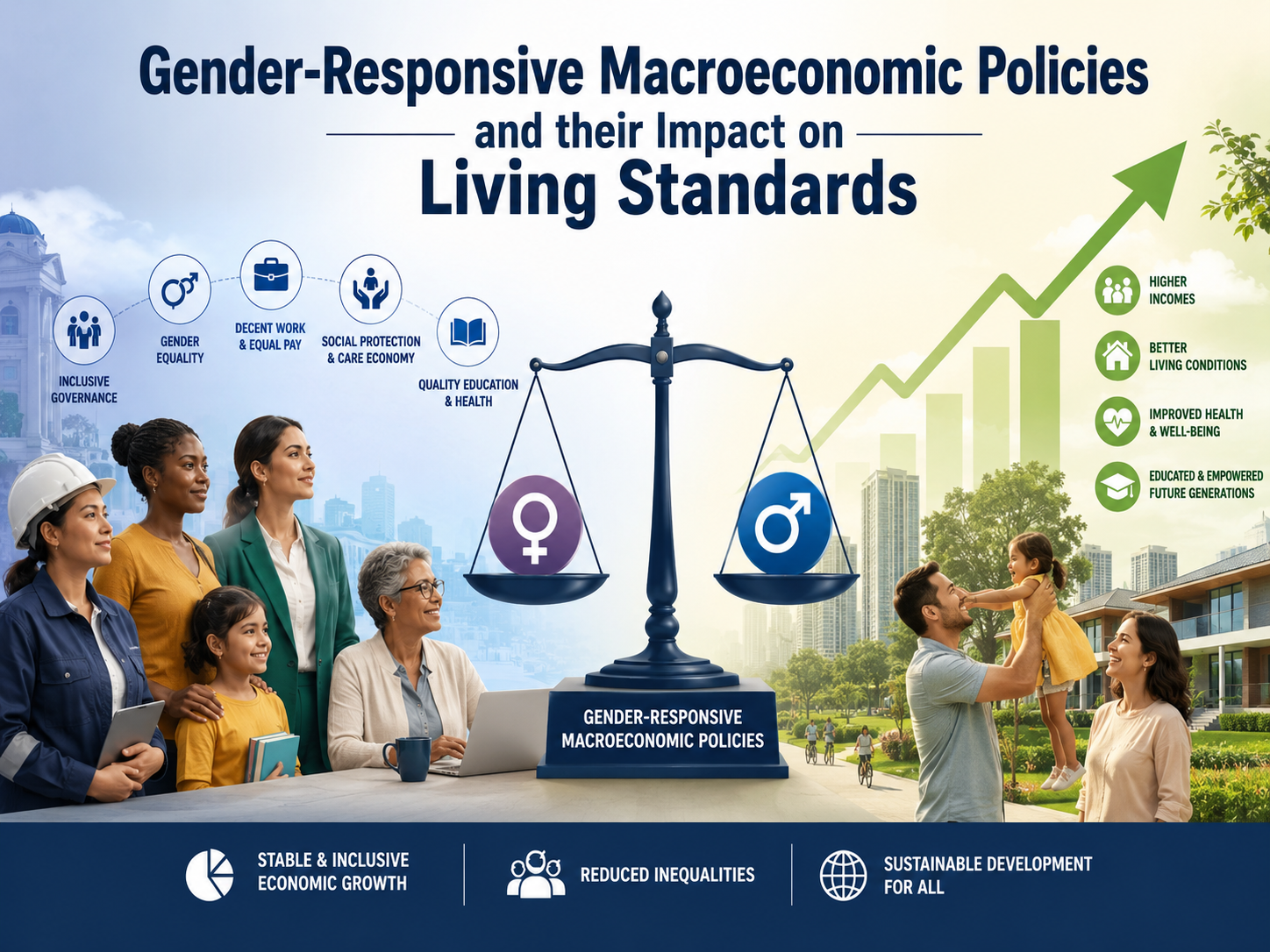
Gender-Responsive Macroeconomic Policies and their Impact on Living Standards in East and West Africa: A Comparative Analysis of Kenya and Nigeria

Downloads
Although gender justice has become an increasingly important aspect of economic development, significant research gaps remain in understanding how different stages of the business cycle, including macroeconomic policies, affect men and women in distinct ways. Africa's economic landscape is characterized by its diversity, featuring unique macroeconomic environments in both East and West Africa. This paper examines the interplay between gender and macroeconomic policy in Kenya, East Africa and Nigeria, West Africa. This research employs an explanatory mixed-methods approach by integrating quantitative analysis of disaggregated macroeconomic data such as GDP growth, inflation, unemployment, and poverty with qualitative insights from interviews and focus group discussions on Kenya and Nigeria. The findings of this study reveal that (1) although economic expansion enhances employment prospects, its advantages are unevenly distributed, favouring men, especially in male-dominated industries. (2) Inflation demonstrably exerts a markedly more adverse effect on women's living standards owing to their predominance in informal jobs and caregiving positions. (3) Moreover, households led by females are over twice as likely to encounter poverty in comparison to those led by males. The study concludes with policy proposals aimed at strengthening gender-responsive budgeting, broaden social infrastructure, and improve institutional accountability to attain equitable and sustainable growth. Therefore, policy makers should advocate for a more inclusive macroeconomic framework that incorporates gender analysis into fiscal and labor policies.
Braun, V. and Clarke, V. (2006). “Using thematic analysis in Psychology.” Qualitative research in Psychology, 3(2), pp. 77-101. http://doi.org/10.1191/1478088706qp063oa
Cohen, L., Lawrence, M., and Keith, M. (2011). Planning educational research: Research Methods in Education. New York: Routledge.
Creswell, J. W. (2012). Educational research: Planning, conducting, and evaluating quantitative and qualitative research (4th ed.). Boston, MA: Pearson.
Culotta, F. (2023). Gender-Responsive Regional Fiscal Policies: The labour market. in measuring gender equality: A multidisciplinary analysis of some EU countries. Cham: Springer International Publishing. http://doi.org/10.1007/978-3-031-41486-2_8
DeGhetto, K., Gray, J. R., & Kiggundu, M. N. (2016). The African Union’s Agenda 2063: Aspirations, Challenges, and Opportunities for Management Research. Africa Journal of Management, 2(1), 93–116. https://doi.org/10.1080/23322373.2015.1127090
East African Community, 2018. East African Community Gender Policy
Ekeruche, M.A., Heitzig, C., Adenuga, O., Folarin, O. and Bahago, K. (2023). Effects of gender-inequality during global health emergencies: Evidence from Nigeria. Red Sur working paper N09/2023.
Fabrizio, S., Goyal, R., Kolovich, L., and Newiak, M. (2024). 9 Socio-economic benefits of gender responsive policies.
Goyal, R. and R. Sahay (2023), “Integrating gender into the IMF’s work”, Gender Notes, No. 2023/001, International Monetary Fund, Washington, DC, https://doi.org/10.5089/9798400257247.067.
IMF (2024), “Interim guidance note on mainstreaming gender at the IMF”, IMF Policy Paper, No. 2024/003, International Monetary Fund, Washington, DC, https://www.imf.org/en/Publications/Policy-Papers/Issues/2024/01/12/Interim-Guidance-Noteon-Mainstreaming-Gender-at-The-IMF-543779.
International Center for Research on Women (2020). Gender mainstreaming in Kenya policy review and proposed action for the manufacturing sector.
Kenya National Bureau of Statistics (2023). The Kenya Poverty Report; Based on the 2022 Kenya Continuous Household Survey.
Kilimo, M.J. (2022) ‘“You can’t do politics without money”: female politicians, matronage, and the limits of gender quotas in Kenya’, Africa, 92(2), pp. 210–229. https://doi.org/10.1017/S0001972022000092.
National Bureau of Statistics, (2022). Nigeria Multidimensional Poverty Index 2022.
National Bureau of Statistics, (2023). Nigerian Labour Force Statistics Report Q4 2022 & Q1 2023.
National Bureau of Statistics, (2024/2025). Nigeria General Household Survey-Panel (Wave 5)
Ndizera, V. and Muzee, H. (2018). A critical review of Agenda 2063: Business as usual? African Journal of Political Science and International Relations, 12(8), pp.142-154.
Nganga, T. K. (2023). Gender mainstreaming in kenya's trade agreements: The Africa continental free trade area. International Journal of Economics, 8(1), pp.30-55. https://doi.org/10.47604/ijecon.1862
Ojo, T.A. (2023). Women, gender, and financial inclusion. Digital Policy Studies, 2(1), pp.64-70.
Patel, V. (2023). Transformative financing for gender equality and gender responsive budgeting. India & the G20: Legacy & Prospects for Multilateralism amidst a Polycrisis, p.83.
Ufodike, A. and Ally, S. (2023). Enhancing gender-responsive financing in Africa: A sustainable development perspective. In sustainable development in post-pandemic Africa. Taylor & Francis.
UN Women, 2017. Macroeconomic Policy and Women’s Economic Empowerment. Discussion Paper. New York, USA.
UN Women, and Snyder, D., 2020. COVID-19 and the care economy: Immediate action and structural transformation for a gender-responsive recovery. Policy Brief, 16(16).
UN Women, 2021. Women’s Representation in Local Government: A Global analysis
UN Women, 2023. Strengthening PFM Systems for Gender Equality and Women’s Empowerment.
Wanjala, B. (2012). Gender responsive budgeting and its application to planning in Kenya. SID/Society for International Development, Regional Office for Eastern Africa, Nairobi.
Were, W.A. (2022). Gender Responsive Budgeting as an Accelerator to Women’s Economic Empowerment. Pathways to African Feminism and Development: Journal of the African Women Studies Centre, 7(1), pp.99-121.
Copyright (c) 2026 Happiness Anusi, Tabitha Ester Kaburia (Author)

This work is licensed under a Creative Commons Attribution-NonCommercial-NoDerivatives 4.0 International License.
By submitting your manuscript to IJABS, you agree and confirm that the paper you have submitted is your own original and unpublished work, does not contain any defamatory or other unlawful content(s), and you will accept responsibility for plagiarism. You and your co-authors retain copyright and grant BESRA the right of publication, with the work simultaneously licensed under a Creative Commons Attribution License 4.