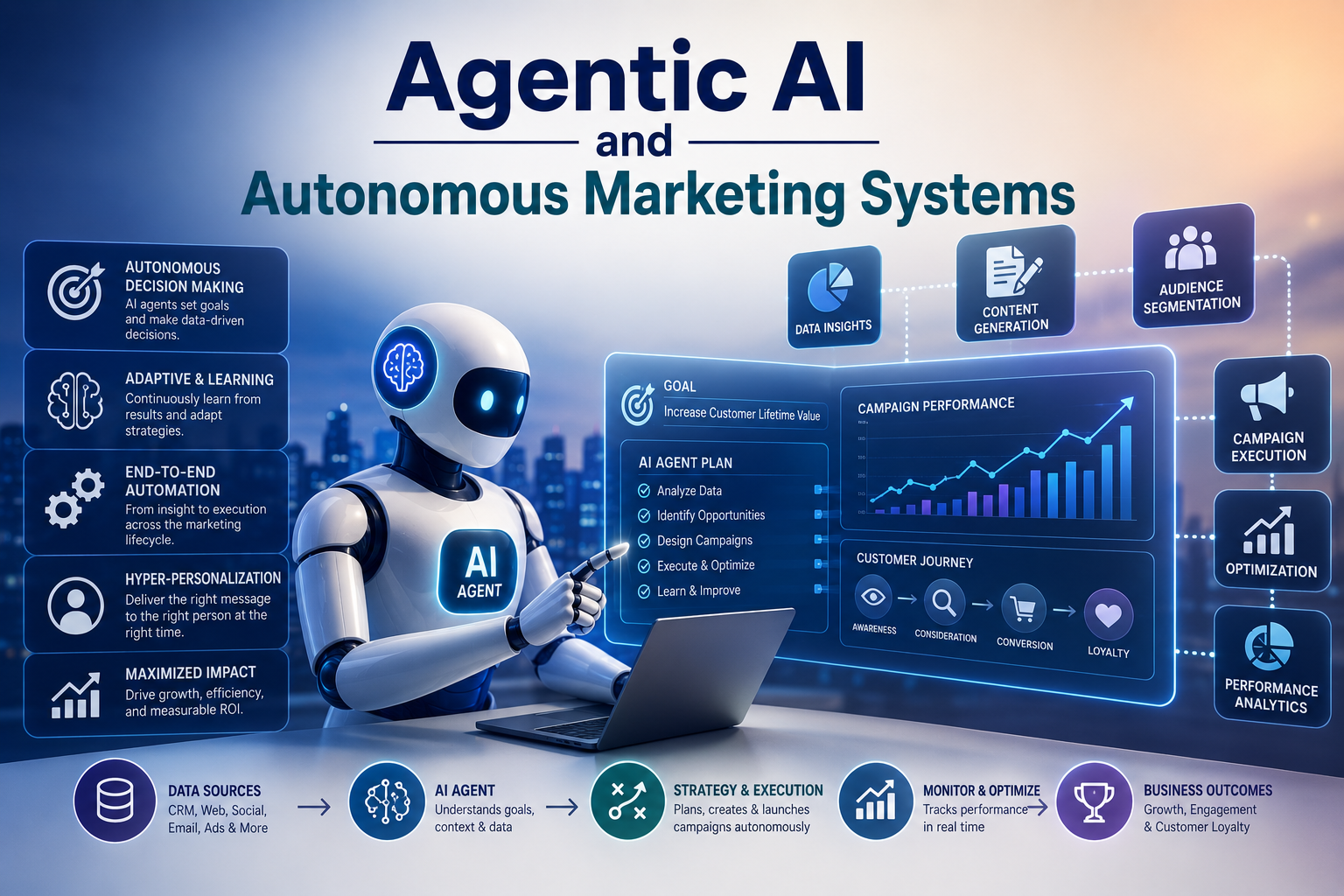
Agentic AI and Autonomous Marketing Systems: A Systematic Review and Integrative Framework

Downloads
Agentic artificial intelligence describes systems that plan and carry out multi-step workflows, use external tools, and adapt from feedback with limited human prompting. In marketing, the shift from content generation to autonomous decision and execution may improve speed, learning, and personalization, while also amplifying governance risks related to privacy, fairness, compliance, and brand harm. An open-source systematic review was conducted using PRISMA 2020, focusing on marketing-relevant applications, autonomy configurations, oversight mechanisms, and reported outcomes. An open-only search of arXiv, ACM Digital Library metadata, and DOI/publisher landing pages yielded 26 eligible studies. Building on this evidence, an integrative framework is proposed that links antecedents, agent design, governance controls, value mechanisms, and performance-risk trade-offs. The paper concludes with a research agenda aimed at producing cumulative, testable knowledge for responsible autonomous marketing systems
Abboud, F. F., Benkhaled, N., Bellaouar, S., Chlimi, K., Chetrit, A., Hadj-Said, A., & Benamar, S. (2025). Agentic personalization: LLM agents for contextual offers and dynamic pricing. arXiv. https://arxiv.org/abs/2506.16429
Agus, A. A., Yudoko, G., Mulyono, N. B., & Nasution, R. A. (2019). Digital publisher, advertising media agency and mobile exchange triadic interaction: Digital marketing service supply chain landscape in Indonesia. In 2019 2nd International Conference on Computer and Informatics Engineering (IC2IE) (pp. 181-187). IEEE. https://doi.org/10.1109/IC2IE47452.2019.8940881
Allouah, A., Besbes, O., Figueroa, J. D., Kanoria, Y., & Kumar, A. (2025). What is your AI agent buying? Evaluation, biases, model dependence, and emerging implications for agentic e-commerce. arXiv. https://arxiv.org/abs/2508.02630
Alramli, H., Mahmood, D., & Khadhim, O. (2020). Network-based model for dissemination of advertising. In 2020 3rd Scientific Conference of Computer Sciences (CSASE). IEEE. https://doi.org/10.1109/CSASE48920.2020.9142074
Chuunga, K., & Mpundu, M. (2025). Organization change through digital transformation. International Journal of Advanced Business Studies, 4(4), 222-235. https://doi.org/10.59857/tuym6309
Chuunga, K., Mpundu, M., & Qutieshat, A. (2025). The role of digital marketing in the flourishing of international businesses. International Journal of Advanced Business Studies, 4(2), 7-21. https://doi.org/10.59857/LHHJ1084
Cillo, P., & Rubera, G. (2025). Generative AI in innovation and marketing processes: A roadmap of research opportunities. Journal of the Academy of Marketing Science, 53(3), 684-701. https://doi.org/10.1007/s11747-024-01044-7
Cui, H. (2024). Generative AI as cross-border opportunity and challenge: A framework for international brand building with LLM agents. arXiv. https://arxiv.org/abs/2411.17700
Dehuri, S., Jagadev, A. K., & Panda, M. (2008). Honey bee behavior: A multi-agent approach for multiple campaigns assignment problem. In 2008 International Conference on Information Technology (ICIT). IEEE. https://doi.org/10.1109/ICIT.2008.14
European Parliament and Council of the European Union. (2024). Regulation (EU) 2024/1689 of the European Parliament and of the Council of 13 June 2024 laying down harmonised rules on artificial intelligence (Artificial Intelligence Act) and amending certain Union acts. Official Journal of the European Union. https://eur-lex.europa.eu/eli/reg/2024/1689/oj
Farseev, M., Cherepanova, M., Schmid, L. A., & Vukovic, I. (2025). Marketing autopilots: A multi-agent architecture for autonomous campaign optimization. arXiv. https://arxiv.org/abs/2512.04112
Flores, L. J. Y., Shen, J., & Gu, G. (2025). Towards reliable multi-agent systems for marketing applications via reflection, memory, and planning. arXiv. https://arxiv.org/abs/2508.11120
Gnewuch, U., Morana, S., Hinz, O., & Kellner, A. (2024). More than a bot? The impact of disclosing human involvement on customer interactions with hybrid service agents. Information Systems Research, 35(2), 722-742. https://doi.org/10.1287/isre.2022.0152
Grewal, D., Satornino, C. B., Davenport, T., & Guha, A. (2025). How generative AI is shaping the future of marketing. Journal of the Academy of Marketing Science, 53(3), 702-722. https://doi.org/10.1007/s11747-024-01064-3
Jafari, M., Shahbazi, A., Kawsar, M., Mousavi Davoudi, S. P., & Janani, S. (2025). The role of artificial intelligence in strategic planning and competitive advantage. International Journal of Advanced Business Studies, 4(4), 258-276. https://doi.org/10.59857/mvzl8684
Jeunen, O., & Wheeler, B. (2025). Personalized AI assistant messaging in a financial-services mobile app. arXiv. https://arxiv.org/abs/2512.17462
Ju, H., & Aral, S. (2025). Collaborating with AI agents: Field experiments on teamwork, productivity, and performance. arXiv. https://arxiv.org/abs/2503.18238
Kshetri, N. (2025). From predictive and generative to agentic AI: Shaping the future of marketing operations and strategies. Computer, 58(4), 121-129. https://doi.org/10.1109/MC.2025.3530304
Ledro, C., Nosella, A., Vinelli, A., Dalla Pozza, I., & Souverain, T. (2025). Artificial intelligence in customer relationship management: A systematic framework for a successful integration. Journal of Business Research, 199, 115531. https://doi.org/10.1016/j.jbusres.2025.115531
Lee, R., Liu, J. N. K., Yeung, K. S. Y., Sin, K. W. S., & Shum, H. K. (2009). Agent-based web content engagement time. In 2009 Ninth International Conference on Intelligent Systems Design and Applications (ISDA). IEEE. https://doi.org/10.1109/ISDA.2009.189
Mariani, M. M., Borghi, M., & Gretzel, U. (2022). AI in marketing, consumer research and psychology: A systematic literature review and research agenda. Psychology & Marketing, 39(4), 755-776. https://doi.org/10.1002/mar.21619
National Institute of Standards and Technology. (2023). Artificial Intelligence Risk Management Framework (AI RMF 1.0). https://doi.org/10.6028/NIST.AI.100-1
Page, M. J., McKenzie, J. E., Bossuyt, P. M., Boutron, I., Hoffmann, T. C., Mulrow, C. D., et al. (2021). The PRISMA 2020 statement: An updated guideline for reporting systematic reviews. BMJ, 372, n71. https://doi.org/10.1136/bmj.n71
Paul, J., & Criado, A. R. (2020). The art of writing literature review: What do we know and what do we need to know? International Business Review, 29(4), 101717. https://doi.org/10.1016/j.ibusrev.2020.101717
Runkana, S., Das, S., Gupta, A., & Runkana, S. (2025). Agentic AI in marketing and commerce: A survey on opportunities, risks, and research directions. arXiv. https://arxiv.org/abs/2504.00338
Saura, J. R., Ribeiro-Soriano, D., & Palacios-Marques, D. (2021). Setting B2B digital marketing in artificial intelligence-based CRMs: A review and directions for future research. Industrial Marketing Management, 98, 161-178. https://doi.org/10.1016/j.indmarman.2021.08.006
Shahbazi, A., Jafari, M., Kawsar, M., Janani, S., & Nadra, S. (2026). AI in data-driven decision making, organizational change, and ethical considerations in business strategy. International Journal of Advanced Business Studies, 5(1), 1-20. https://doi.org/10.59857/wpgh3w33
Snyder, H. (2019). Literature review as a research methodology: An overview and guidelines. Journal of Business Research, 104, 333-339. https://doi.org/10.1016/j.jbusres.2019.07.039
Sousa, D. N., Brito, M. A., & Argainha, C. (2019). Virtual customer service: Building your chatbot. In Proceedings of the 3rd International Conference on Business and Information Management (ICBIM '19) (pp. 174-179). Association for Computing Machinery. https://doi.org/10.1145/3361785.3361805
Stöckl, A., & Nitu, J. (2025). Are AI agents interacting with online ads? arXiv. https://arxiv.org/abs/2504.07112
Terano, T., & Naitoh, K. (2004). Agent-based modeling for competing firms. In Proceedings of the 37th Annual Hawaii International Conference on System Sciences (HICSS '04). IEEE. https://doi.org/10.1109/HICSS.2004.1265251
Varma, V. S., Morarescu, I.-C., & Lasaulce, S. (2018). Marketing resource allocation in duopolies over social networks. IEEE Control Systems Letters, 2(4), 593-598. https://doi.org/10.1109/LCSYS.2018.2846185
Wang, L., Luo, C., Wang, Y., Liu, Y., Chen, K., Zhang, J., Yu, B., & Zhang, X. (2023). A survey of large language model-based autonomous agents. arXiv. https://arxiv.org/abs/2308.11432
Wu, J., Yang, C., Wu, Y., Mahns, S., Wang, C., Zhu, H., Fang, F., & Xu, H. (2025). AI Realtor: Towards grounded persuasive language generation for automated copywriting. arXiv. https://arxiv.org/abs/2502.16810
Xu, D., Zhang, D., Yang, G., Yang, B., Xu, S., Zheng, L., & Liang, C. (2024). Survey for landing generative AI in social and e-commerce recsys -- the industry perspectives. arXiv. https://arxiv.org/abs/2406.06475
Copyright (c) 2026 Emad Ramezanie (Author)

This work is licensed under a Creative Commons Attribution-NonCommercial-NoDerivatives 4.0 International License.
By submitting your manuscript to IJABS, you agree and confirm that the paper you have submitted is your own original and unpublished work, does not contain any defamatory or other unlawful content(s), and you will accept responsibility for plagiarism. You and your co-authors retain copyright and grant BESRA the right of publication, with the work simultaneously licensed under a Creative Commons Attribution License 4.