Nature Needs Underwriters: Redefining the Role of Insurance in African Conservation Policy

Downloads
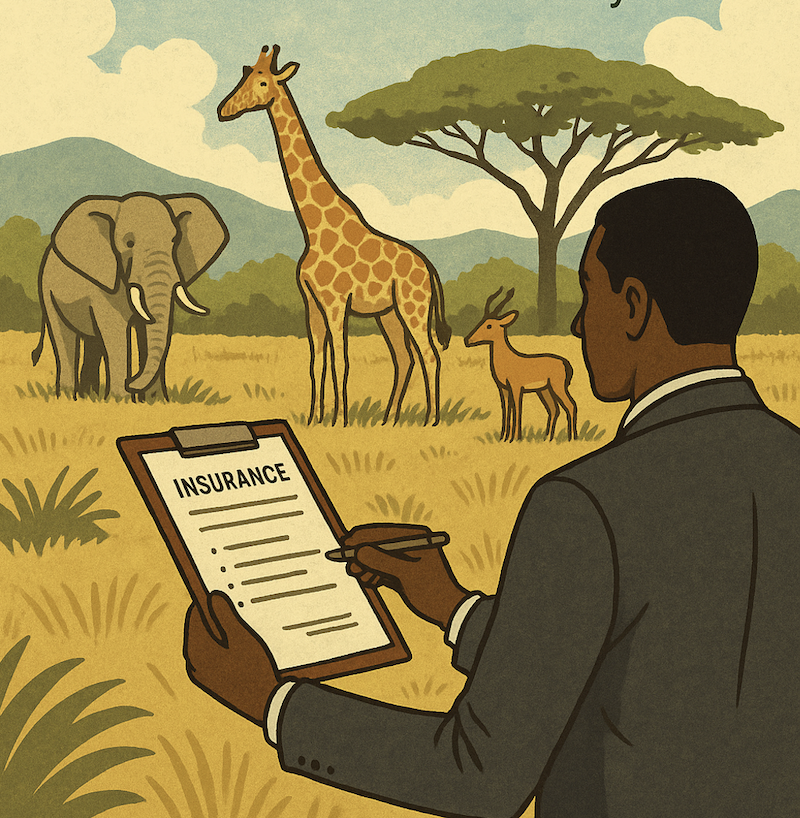
Human-wildlife conflict (HWC) presents a significant and escalating challenge across Africa, undermining both conservation efforts and the livelihoods of local communities. As human populations expand and pressures such as habitat loss, climate change, and increased human-wildlife interactions intensify, there is a pressing need for innovative solutions to mitigate the adverse impacts on both wildlife and human populations. The insurance sector has emerged as a promising tool for risk management, offering compensation mechanisms that can alleviate the financial burdens experienced by affected communities. However, the effectiveness of insurance-based solutions hinges on the active collaboration of multiple stakeholders, including governments, non-governmental organizations (NGOs), international agencies, and local communities. This article examines the global context of HWC, with a particular focus on Sub-Saharan Africa, exploring the roles and contributions of key stakeholders and the potential of the insurance sector in mitigating HWC. Through a comprehensive desktop research methodology, the article critically evaluates existing approaches and highlights the importance of an integrated insurance framework that incorporates robust government policies and international partnerships. The findings underscore that effective, sustainable management of HWC requires a collaborative, multi-sectoral approach that combines insurance mechanisms with broader conservation strategies.
Agrawal, A., & Lemos, M. C. (2007). A greener revolution in the making? Environmental governance in the 21st century. Environment: Science and Policy for Sustainable Development, 49(5), 36-45.
Arias, P., Bellouin, N., Coppola, E., Jones, R., Krinner, G., Marotzke, J., ... & Zickfeld, K. (2021). Climate Change 2021: the physical science basis. Contribution of Working Group I to the Sixth Assessment Report of the Intergovernmental Panel on Climate Change; technical summary.
Armitage, D. (2005). Adaptive capacity and community-based natural resource management. Environmental management, 35, 703-715.
Barnes, J., & Jones, B. (2012). Game ranching in Namibia. In Evolution and innovation in wildlife conservation (pp. 113-126). Routledge.
Barua, M., Bhagwat, S. A., & Jadhav, S. (2013). The hidden dimensions of human–wildlife conflict: Health impacts, opportunity and transaction costs. Biological conservation, 157, 309-316.
Berkes, F. (2007). Community-based conservation in a globalized world. Proceedings of the National academy of sciences, 104(39), 15188-15193
Bjarnegård, E., & Kenny, M. (2015). Revealing the “secret garden”: The informal dimensions of political recruitment. Politics & Gender, 11(4), 748-753.
Bulte, E., & Rondeau, D. (2007). Compensation for wildlife damages: Habitat conversion, species preservation and local welfare. Journal of Environmental Economics and Management, 54(3), 311-322.
Costanza, R., d'Arge, R., De Groot, R., Farber, S., Grasso, M., Hannon, B., ... & Van Den Belt, M. (1997). The value of the world's ecosystem services and natural capital. nature, 387(6630), 253-260.
Costanza, R., De Groot, R., Sutton, P., Van der Ploeg, S., Anderson, S. J., Kubiszewski, I., ... & Turner, R. K. (2014). Changes in the global value of ecosystem services. Global environmental change, 26, 152-158.
Daily, G. C. (1997). Introduction: what are ecosystem services. Nature’s services: Societal dependence on natural ecosystems, 1(1).
Dao, H., Peduzzi, P., & Friot, D. (2018). National environmental limits and footprints based on the Planetary Boundaries framework: The case of Switzerland. Global environmental change, 52, 49-57
Dercon, S., Hill, R. V., Clarke, D., Outes-Leon, I., & Taffesse, A. S. (2014). Offering rainfall insurance to informal insurance groups: Evidence from a field experiment in Ethiopia. Journal of Development Economics, 106, 132-143.
Dickman, A. J. (2010). Complexities of conflict: the importance of considering social factors for effectively resolving human–wildlife conflict. Animal conservation, 13(5), 458-466.
Dickman, A. J., Macdonald, E. A., & Macdonald, D. W. (2011). A review of financial instruments to pay for predator conservation and encourage human–carnivore coexistence. Proceedings of the national academy of Sciences, 108(34), 13937-13944.
Duriez, O., Kato, A., Tromp, C., Dell'Omo, G., Vyssotski, A. L., Sarrazin, F., & Ropert-Coudert, Y. (2014). How cheap is soaring flight in raptors? A preliminary investigation in freely-flying vultures. PloS one, 9(1), e84887
Eksvärd, K., & Marquardt, K. (2018). From change to transition? Learning from environmental protection activities in Sweden. Agroecology and Sustainable Food Systems, 42(2), 189-209
Ellis, F. (2000). The determinants of rural livelihood diversification in developing countries. Journal of agricultural economics, 51(2), 289-302.
Fernando, P., Wikramanayake, E. D., Janaka, H. K., Jayasinghe, L. K. A., Gunawardena, M., Kotagama, S. W., ... & Pastorini, J. (2008). Ranging behavior of the Asian elephant in Sri Lanka. Mammalian Biology, 73(1), 2-13
Folke, C., Hahn, T., Olsson, P., & Norberg, J. (2005). Adaptive governance of social-ecological systems. Annu. Rev. Environ. Resour., 30(1), 441-473.
Friedlingstein, P., O'sullivan, M., Jones, M. W., Andrew, R. M., Hauck, J., Olsen, A., ... & Zaehle, S. (2020). Global carbon budget 2020. Earth System Science Data Discussions, 2020, 1-3.
Goergen, J. D., Louis, M. P., Kellner, K. F., Roloff, G. J., Lindeque, M., & Belant, J. L. (2025). Local management and governance improve natural resource incomes of communal conservancies in Namibia. Conservation Science and Practice, e70054.
Hansen, J., Sato, M., & Ruedy, R. (2012). Perception of climate change. Proceedings of the National Academy of Sciences, 109(37), E2415-E2423.
Hardin, G. (1974). The tragedy of the commons. Crowding and Behavior, 162(8.5699198).
Harrison, R. D., Thierfelder, C., Baudron, F., Chinwada, P., Midega, C., Schaffner, U., & Van Den Berg, J. (2019). Agro-ecological options for fall armyworm (Spodoptera frugiperda JE Smith) management: Providing low-cost, smallholder friendly solutions to an invasive pest. Journal of environmental management, 243, 318-330.
Hazzah, L., Mulder, M. B., & Frank, L. (2009). Lions and warriors: social factors underlying declining African lion populations and the effect of incentive-based management in Kenya. Biological Conservation, 142(11), 2428-2437.
Kissui, B. M., Kisimir, E. L., Lichtenfeld, L. L., Naro, E. M., Montgomery, R. A., & Kiffner, C. (2022). Human-carnivore coexistence in the Tarangire ecosystem. In Tarangire: Human-wildlife coexistence in a fragmented ecosystem (pp. 295-317). Cham: Springer International Publishing.
Kooiman, J. (2003). Societal governance (pp. 229-250). vs Verlag für Sozialwissenschaften.
Li, L. L., Wang, Q. Y., Yang, H. P., Tao, Y. X., Wang, L. X., Yang, Z. B., ... & Quan, R. C. (2023). Mobile animals and immobile protected areas: improving the coverage of nature reserves for Asian elephant conservation in China. Oryx, 57(4), 532-539
Li, W., Liu, P., Yang, N., Pan, H., Chen, S., & Zhang, L. (2023). Spatio‐temporal trend and mitigation of human–elephant conflict in Xishuangbanna, China. The Journal of Wildlife Management, 87(8), e22485.
Lindsey, P. A., Balme, G., Becker, M., Begg, C., Bento, C., Bocchino, C., ... & Zisadza-Gandiwa, P. (2013). The bushmeat trade in African savannas: Impacts, drivers, and possible solutions. Biological conservation, 160, 80-96.
Linnell, J. D., Broseth, H., Odden, J., & Nilsen, E. B. (2010). Sustainably harvesting a large carnivore? Development of Eurasian lynx populations in Norway during 160 years of shifting policy. Environmental management, 45, 1142-1154
McShane, T. O., Hirsch, P. D., Trung, T. C., Songorwa, A. N., Kinzig, A., Monteferri, B., ... & O’Connor, S. (2011). Hard choices: Making trade-offs between biodiversity conservation and human well-being. Biological conservation, 144(3), 966-972.
Mensah, E. J. (2011). The sustainable livelihood framework: A reconstruction.
Mishra, A. K., & Singh, V. P. (2011). Drought modeling–A review. Journal of Hydrology, 403(1-2), 157-175.
Murphree, M. W. (2009). The strategic pillars of communal natural resource management: benefit, empowerment and conservation. Biodiversity and Conservation, 18, 2551-2562
Naidoo, G. (2016). The mangroves of South Africa: An ecophysiological review. South African Journal of Botany, 107, 101-113.
North, D. C. (1990). A transaction cost theory of politics. Journal of theoretical politics, 2(4), 355-367.
Olaussen, J. O. (2018). Environmental problems and regulation in the aquaculture industry. Insights from Norway. Marine Policy, 98, 158-163.
Ostrom, E. (2009). A general framework for analyzing sustainability of social-ecological systems. Science, 325(5939), 419-422.
Pagiola, S., Agostini, P., Gobbi, J., Haan, C. D., Ibrahim, M., Murgueitio, E., ... & Ruíz, J. P. (2004). Paying for biodiversity conservation services in agricultural landscapes.
Redpath, S. M., Young, J., Evely, A., Adams, W. M., Sutherland, W. J., Whitehouse, A., ... & Gutierrez, R. J. (2013). Understanding and managing conservation conflicts. Trends in ecology & evolution, 28(2), 100-109.
Scoones, I. (2009). The politics of global assessments: the case of the International Assessment of Agricultural Knowledge, Science and Technology for Development (IAASTD). The Journal of Peasant Studies, 36(3), 547-571.
Sunderlin, W. D., Angelsen, A., Belcher, B., Burgers, P., Nasi, R., Santoso, L., & Wunder, S. (2005). Livelihoods, forests, and conservation in developing countries: an overview. World development, 33(9), 1383-1402.
Surminski, S., & Oramas-Dorta, D. (2014). Flood insurance schemes and climate adaptation in developing countries. International Journal of Disaster Risk Reduction, 7, 154-164.
Suryawanshi, K. R., Bhatia, S., Bhatnagar, Y. V., Redpath, S., & Mishra, C. (2014). Multiscale factors affecting human attitudes toward snow leopards and wolves. Conservation Biology, 28(6), 1657-1666.
Treves, A., & Karanth, K. U. (2003). Human‐carnivore conflict and perspectives on carnivore management worldwide. Conservation biology, 17(6), 1491-1499
Treves, A., Krofel, M., Ohrens, O., & Van Eeden, L. M. (2019). Predator control needs a standard of unbiased randomized experiments with cross-over design. Frontiers in Ecology and Evolution, 7, 462.
Warren, M. E. (2009). Governance-driven democratization. Critical policy studies, 3(1), 3-13.
WINNIE, C. (2023). Mega-Projects, Land Tenure and Local Institutions Changes in Nakuprat-Gotu Community Conservancy in Isiolo County, Kenya (Doctoral dissertation, Kenyatta University).
Zabel, A., & Holm-Müller, K. (2008). Conservation performance payments for carnivore conservation in Sweden. Conservation biology, 22(2), 247-251.
Zimmermann, N. E., Edwards Jr, T. C., Graham, C. H., Pearman, P. B., & Svenning, J. C. (2010). New trends in species distribution modelling. Ecography, 33(6), 985-989.
Copyright (c) 2025 Agripah Marangwanda (Author)

This work is licensed under a Creative Commons Attribution-NonCommercial-NoDerivatives 4.0 International License.
By submitting your manuscript to IJABS, you agree and confirm that the paper you have submitted is your own original and unpublished work, does not contain any defamatory or other unlawful content(s), and you will accept responsibility for plagiarism. You and your co-authors retain copyright and grant BESRA the right of publication, with the work simultaneously licensed under a Creative Commons Attribution License 4.